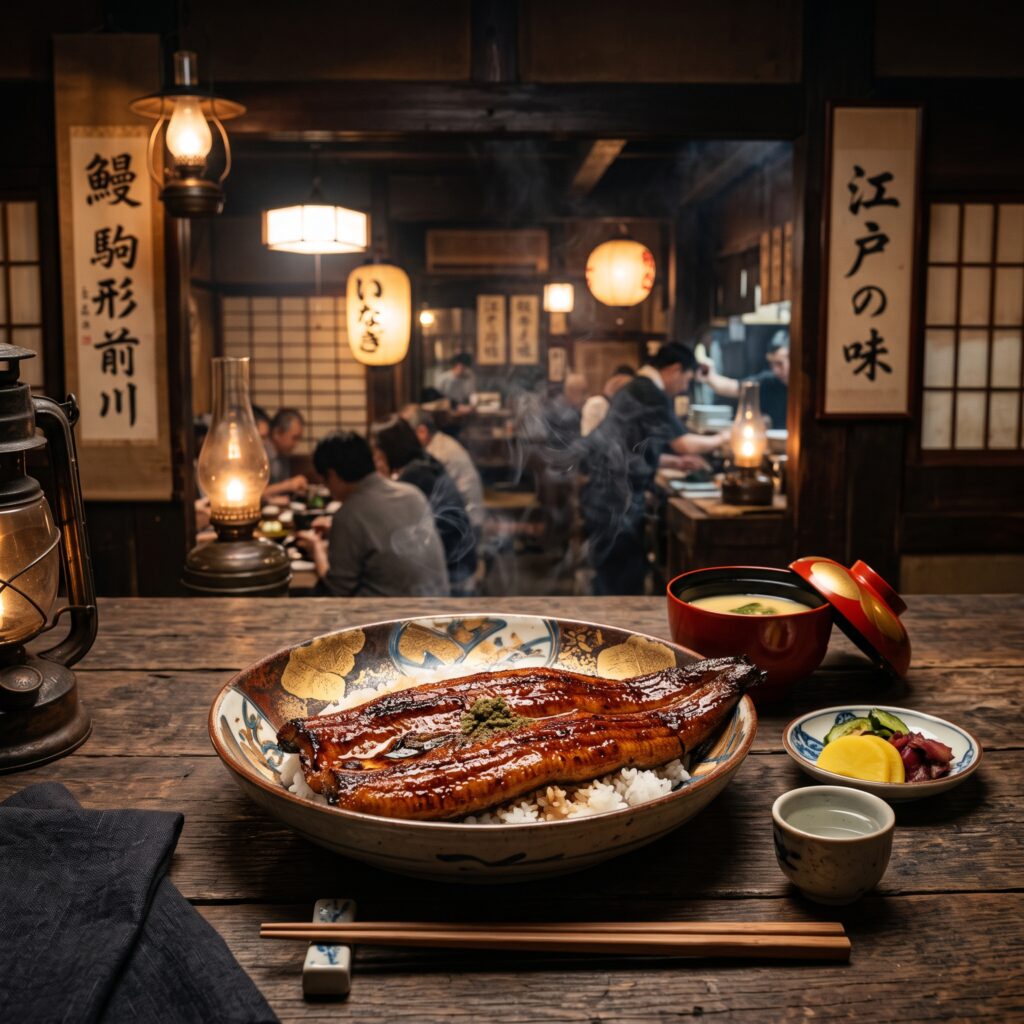
During the Edo period, Unagi no Kabayaki (grilled eel glazed with sweet soy sauce) became one of the most beloved culinary traditions in Edo (modern-day Tokyo). The classic style of Kabayaki—where the eel is filleted, skewered, and grilled while continually brushed with a savory sauce made from soy sauce, mirin, and other seasonings—was widely established during this era.
In Edo, eel was a common and accessible ingredient for everyday people, thanks to the abundance of rivers and marshes where they could be caught. As more and more specialized eel shops opened across the city, the mouthwatering aroma and rich, savory sauce drew in endless crowds. Notably, it became customary in Edo to open the eel from the back (se-biraki). This is said to be because Edo was a town of samurai, and cutting the belly (hara-kiri) was avoided due to its association with ritual suicide.
On the other hand, in the Kamigata region (Kyoto and Osaka), it was standard to open the eel from the belly (hara-biraki). The Tokyo-style preparation method—steaming the filleted eel before final grilling—gives the meat a tender, delicate texture while gently rendering off excess fat.
Furthermore, Unagi no Kabayaki was deeply intertwined with the burgeoning dining-out culture of Edo. Sold not only at specialized restaurants but also at lively street stalls, it served as “Edo’s fast food,” allowing commoners to easily enjoy freshly grilled eel on the go. It was truly an integral part of the Edo cityscape.
The tradition of eating eel on the “Day of the Ox” (Doyo no Ushi no Hi) during midsummer, which continues to this day, is also believed to have spread during the late Edo period. A famous theory suggests that Hiraga Gennai, an inventor and polymath, came up with the promotional slogan “Today is the Day of the Ox” to boost sales for a struggling eel restaurant during the slow summer months. However, several other theories regarding its origin exist as well.
Even today, Unagi no Kabayaki remains a cherished icon of Japanese food culture—a symbol of “Iki” (Edo style and sophistication) nurtured by traditional craftsmanship and the vibrant energy of the town.
And Asakusa was historically “one of the prominent eel districts representing Edo.” Experience the historical atmosphere of Edo while enjoying exquisite eel in Asakusa. Step into Asakusa for a truly sophisticated dining experience.